Move from uncontrolled AI experimentation to governed AI adoption
AI GOVERNANCE ADOPTION AND IMPLEMENTATION
AI use is already spreading through organizations. Some people are becoming highly capable, but the tools, data and working methods involved are not always visible, consistent or governed.That creates a simple problem: capability can move faster than control.The Practice Labs establishes where you stand, identifies where AI can create measurable value, and helps turn the right opportunity into a controlled, practical implementation.
AI Governance Review. £1,950 + VAT.
Fixed fee. Completed within ten working days.
A focused review that establishes where you are, what matters next, and the strongest candidate for practical implementation..

AI adoption is moving. Is it creating measurable value?
The challenge
AI is already being used across many organisations.Some of that use will be approved. Some may not be.Governance matters, but control alone is not the objective. The bigger question is whether AI is improving real work in ways the organisation can see, measure, and safely repeat. That means understanding where AI is being used, which workflows are worth improving, what prevents wider adoption, and where the organisation should concentrate next.
Visibility
Know what is actually happening. Know where AI is used and for what
Consistency
Turn useful personal habits into repeatable practice. Identify where individual success can become a better organisational workflow.
Control
Create the conditions for responsible adoption. Establish the boundaries, responsibilities, and safeguards needed to use AI confidently.
Evidence
Know whether anything actually improved. Measure the operational result rather than relying on projected benefits or anecdotal success.
Capability without control creates exposure. Control without capability constrains value. Neither tells you whether AI is actually improving the organisation.
Readiness is not the destination. It tells us what you are ready to do next
AI readiness
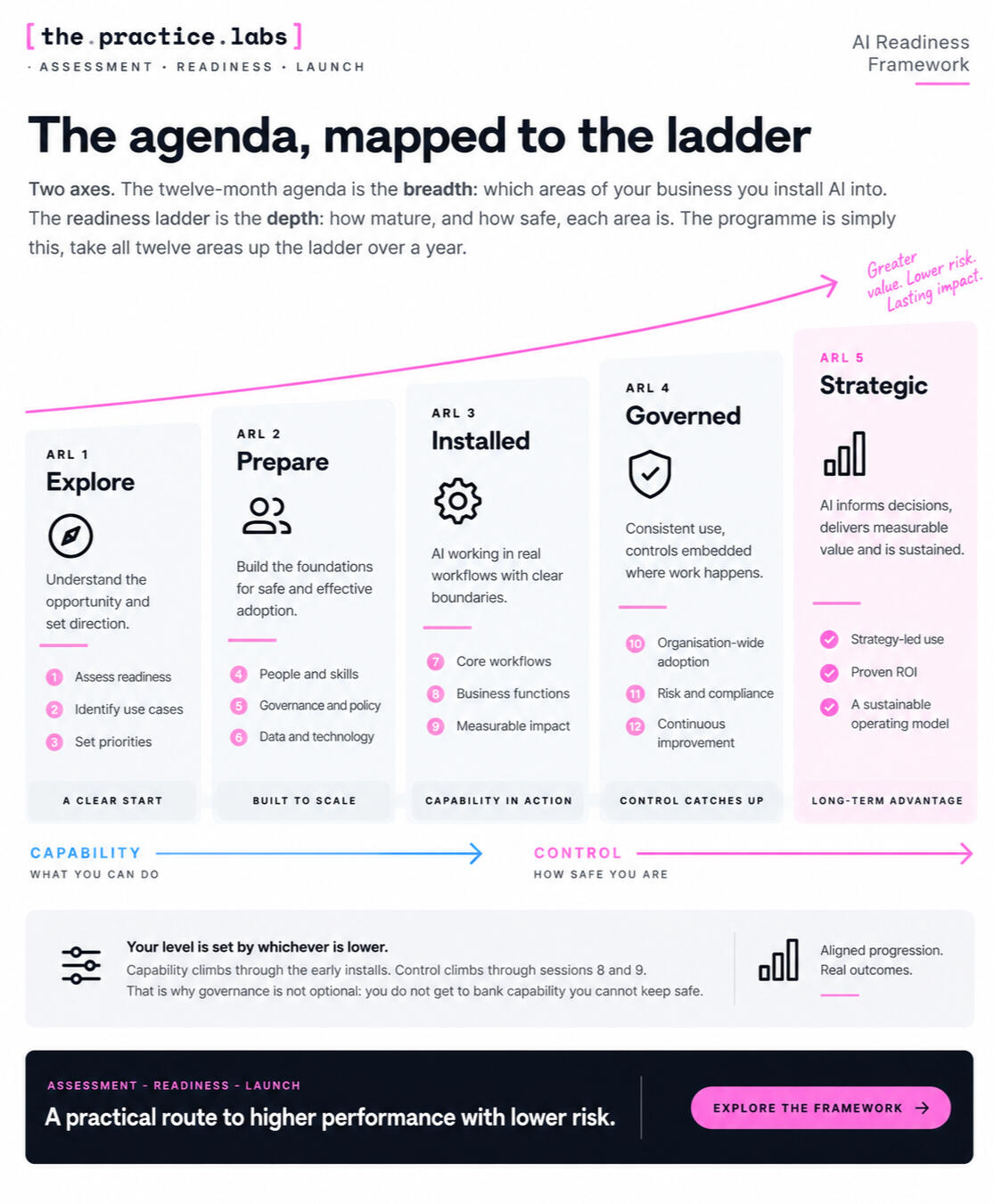
We assess two things separately:
How effectively your organisation can use AI, and how reliably it can govern that use
Capability
The skills, workflows, and tools that turn AI into useful, repeatable work
Control
The accountability, data boundaries, approved tools, and oversight that keep that work governed.We examine both across four dimensions.
People: Do people understand the tools, their responsibilities, and how to use AI effectively.
Process: Is AI being incorporated into defined workflows, or is adoption still largely individual and experimental?
Data: Does the organisation understand what information is entering AI systems, what can be shared, and where controls are required?
Technology: Are the right tools available, appropriately configured, and capable of supporting the organisation's intended use?
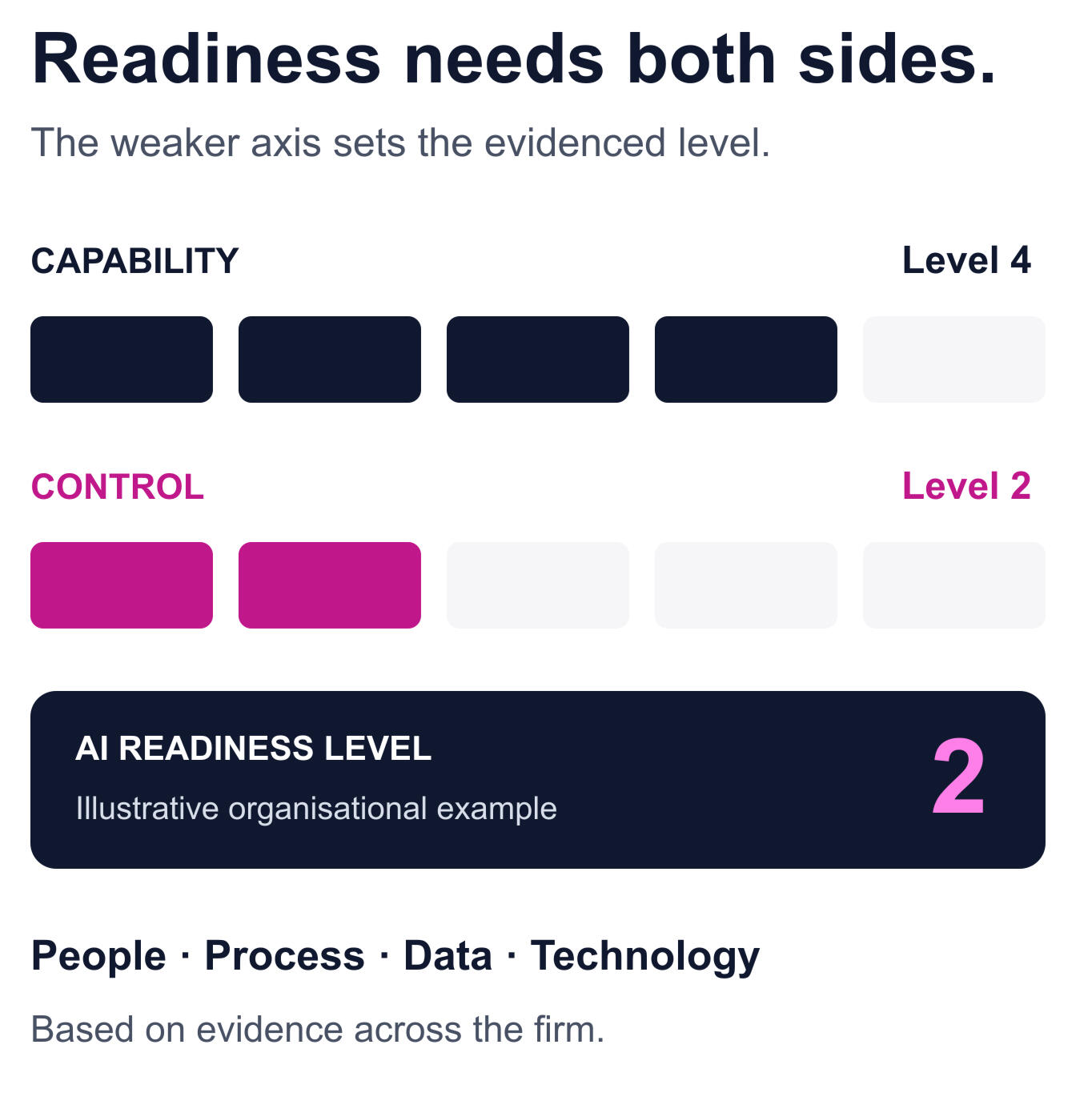
Inspired by NASA’s Technology Readiness Levels. Not affiliated with or certified by NASA.
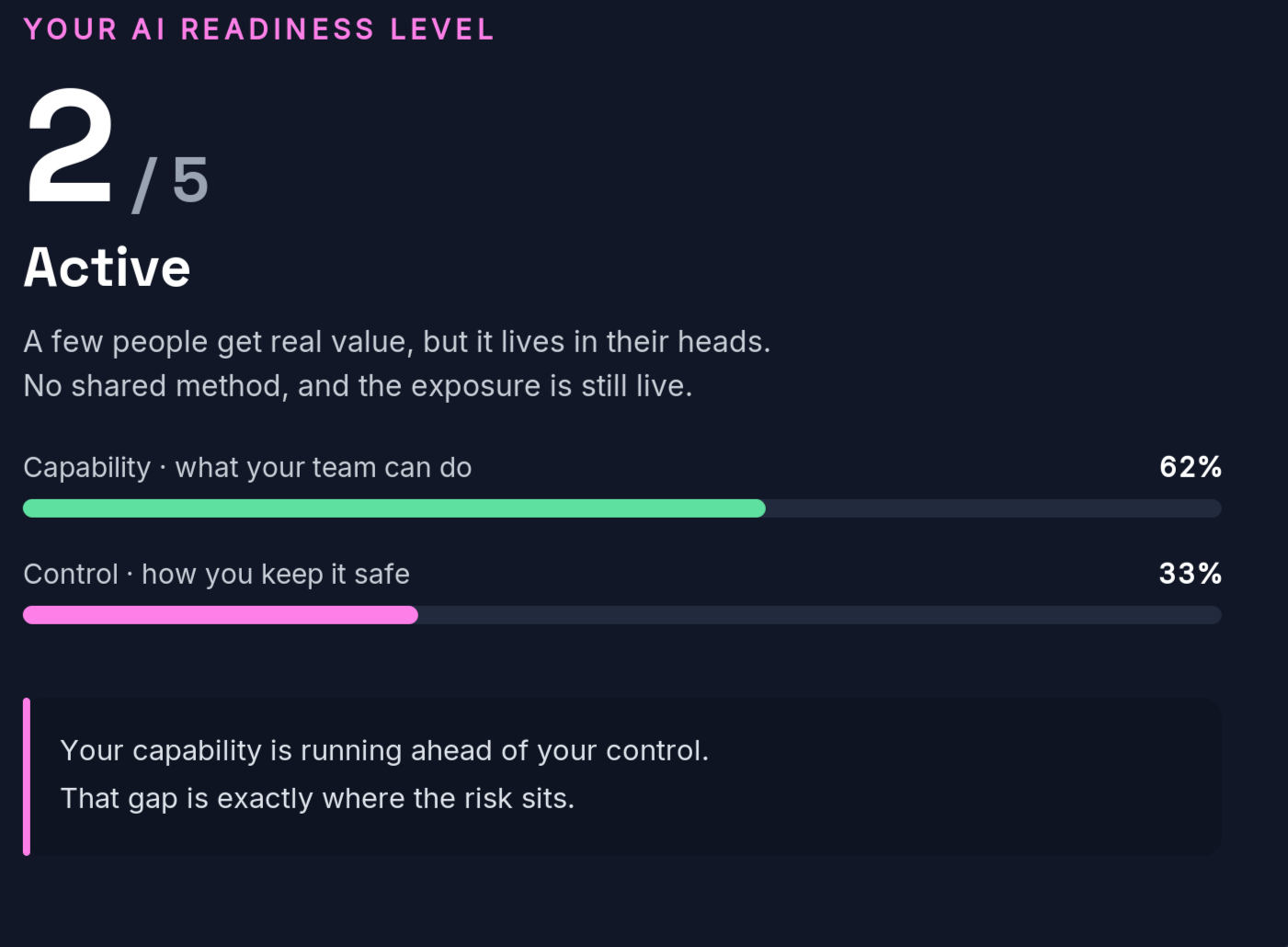
Your AI readiness level, or ARL, is constrained by the weaker axis. Capability at level 4 and control at level 2 means an overall evidenced level of 2. We also show the gap and the evidence behind it, so management can see what needs attention.The result is not a generic maturity score. It is an evidence view of where capability and control are aligned, where they are not, and what needs to happen next.
A clear position. A small number of important decisions. A practical place to start
Fixed fee review
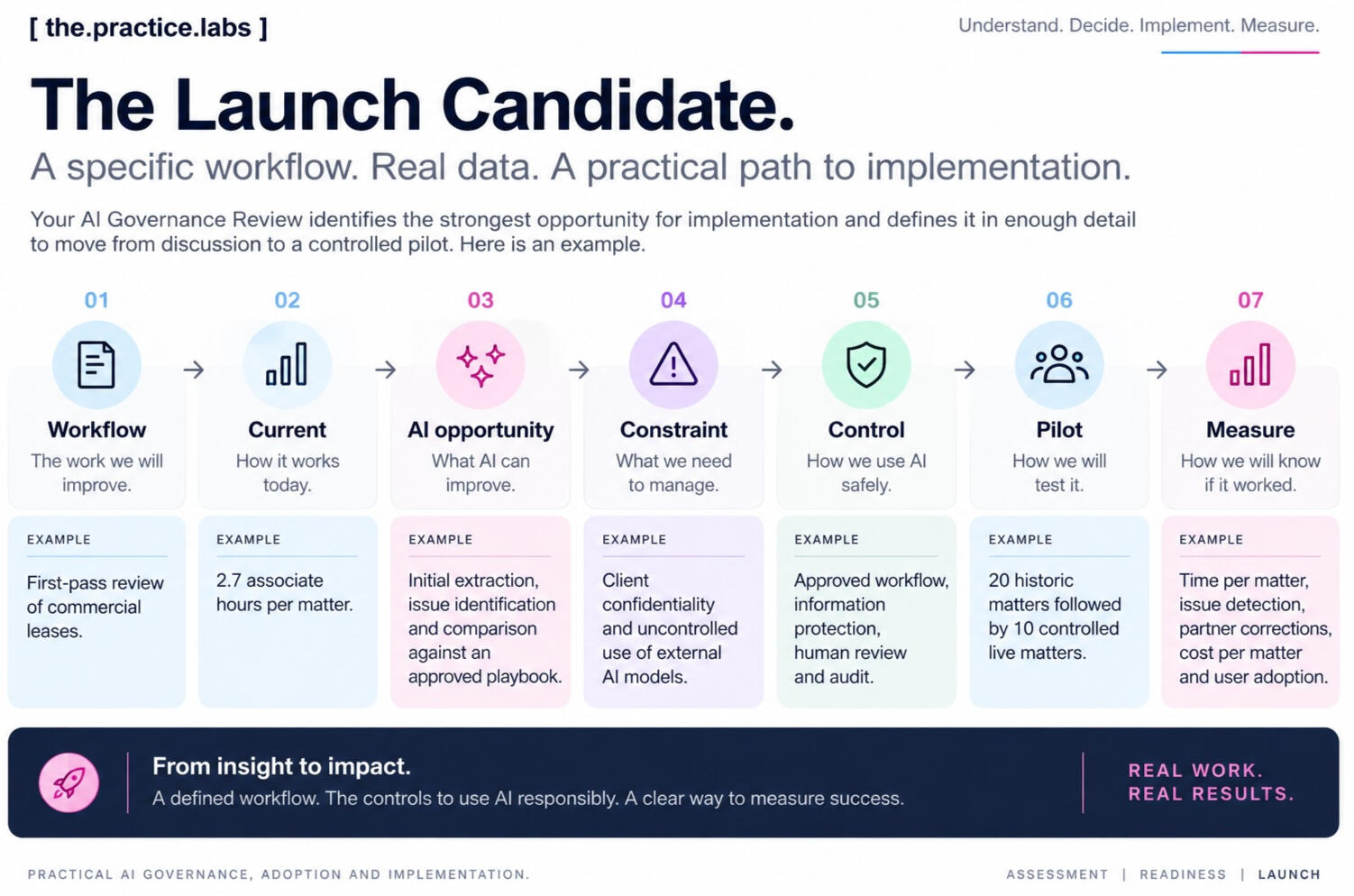
A focused, independent review of your organisation’s AI capability, controls and opportunities.We combine structured assessment, stakeholder input, and evidence of current practise to establish where you stand, what deserves management attention, and where AI could create meaningful operational value.The review concludes by identifying and defining the strongest candidate for practical implementation.We call this the launch candidate: a specific workflow with a current baseline, a defined AI opportunity, identified constraints and controls, and a pilot approach and measurable success criteria.If the evidence shows that the organisation is not yet ready to launch, we will explain precisely what needs to change first.
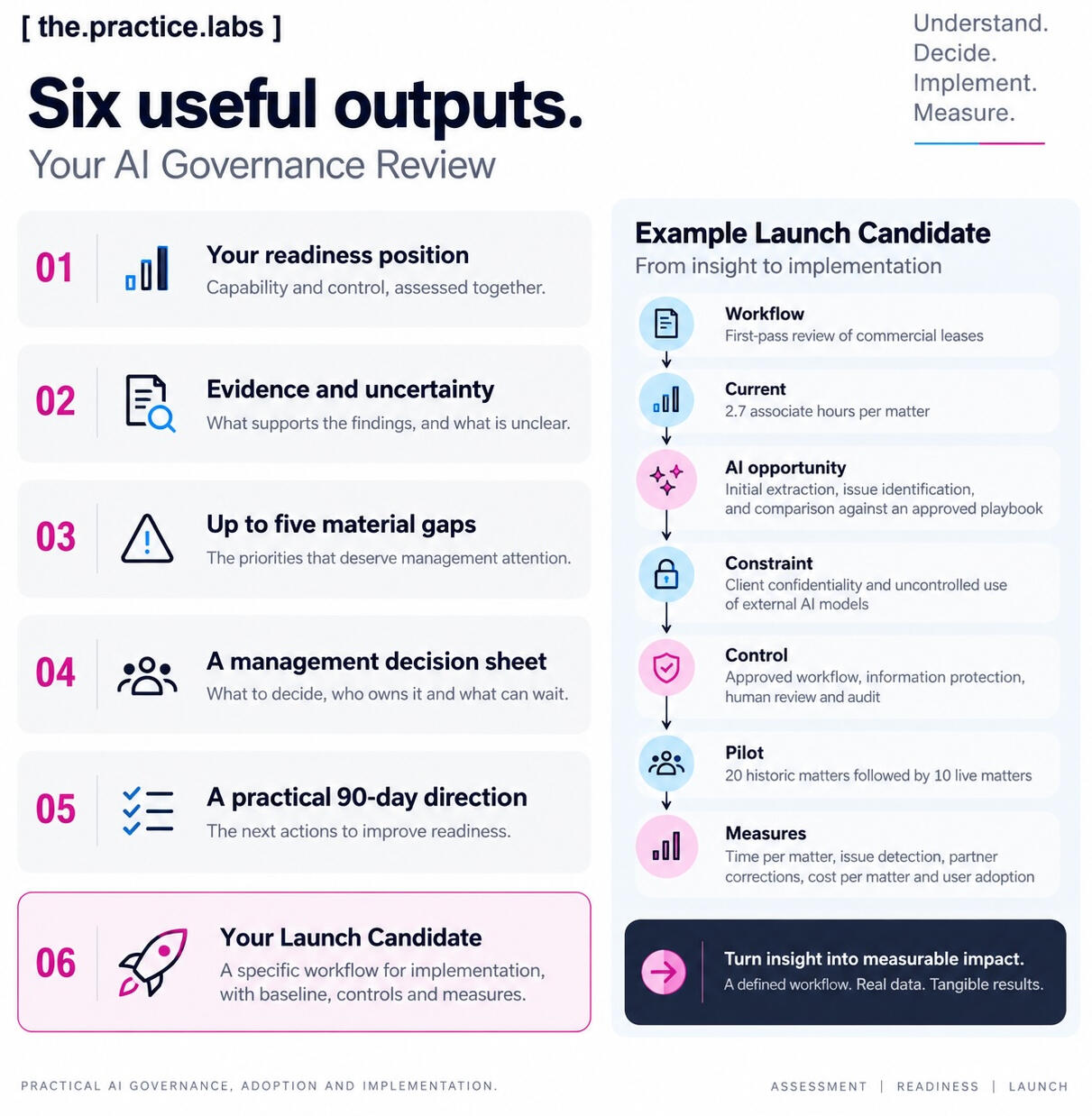
What you receive
£1,950 + VAT
Fixed fee · Completed within ten working days
The Review stands on its own. You can act on the findings internally or discuss further support if the evidence justifies it.There is no requirement to buy technology or commit to a wider programme. The objective is not to produce another report. It is to establish whether there is something worth implementing and, if there is, define it clearly enough to act.
Every useful assessment should eventually answer one question: What should we actually do?
The launch candidate
Where the review identifies a strong opportunity, turn it into a launch candidate.A Launch Candidate is not another strategic recommendation. It is a defined workflow that can be tested against the way the organisation works today.
Different organisations will produce very different launch candidates. It might be:
Contract review
Customer support
Financial analysis
Management reporting
Research document production
Knowledge retrieval
Onboarding
An internal operational process
Understand the work as it operates today. Establish a baseline. Identify what AI can improve. Put the necessary controls around it. Test it in practice. Measure what changes.The principle remains the same.
Assessment. Readiness. Launch.
Our approach
A practical framework for moving from AI ambition to measured implementation. The Practice Labs uses its Assessment-Readiness-Launch framework, or ARL, to move organisations progressively from understanding what is happening to doing something useful about it.
Assessment
Understand where you really are.
Establish how AI is being used, where capability exists, what can be evidenced, where the material risks sit, and which workflows offer meaningful opportunity. We look across people, process, data, and technology, rather than treating AI as a technology question alone.Assessment tells you where you are.
Readiness
Decide what is worth doing. Prioritise the strongest opportunities. Select a workflow, understand how it operates today, and establish its baseline. Define the AI opportunity, constraints, required controls, ownership, and measure of success. Readiness should terminate in something concrete: a launch candidate.Readiness identifies what is worth doing.
launch
Put it into practice and measure what changes. Take the launch candidate into controlled implementation. Start with the baseline. Pilot the smallest useful version against real work. Establish the controls required for responsible operation. Put it into users' hands. Measure what happens. Make an evidence-based decision to scale, modify or stop.Launch finds out whether it actually works.
Understand, decide, implement, measure.
The objective is not AI transformation for its own sake. It is to find work worth improving and create evidence that the improvement is real.
Built for organisations where AI meets valuable or sensitive work
Where we work
We started with professional services for a reason. Law, accountancy, and other advisory firms combine knowledge-intensive work, valuable information, professional obligations, and significant opportunities for AI-enabled productivity.They are an ideal environment in which to apply the Practice Labs approach, but the underlying problem is much broader. Any organisation adopting AI eventually has to answer the same questions:
Where can AI materially improve the way we work?
What is already happening that management cannot see?
Which workflows are worth changing?
What information and systems are involved?
What controls are genuinely necessary?
How will we know whether the change worked?
We connect those questions across people, process, data, and technology.
Our focus is practical: find valuable work, understand the constraints, establish the controls, and create evidence through implementation.
Find out where you stand
Start here
Our free AI readiness check gives you an initial view of the relationship between AI capability and control in your organisation.It takes around 2 minutes and has eight scored questions that gives you an initial indication of how your AI capability and controls compare. You will receive an indicative readiness position and an explanation of what it means. The check is an initial indication, not an organisational assessment.The check is an initial indication, not an organisational assessment. The AI Governance Review establishes the evidence behind your position and identifies what the organisation should do next.
Practical experience across governance, technology, and implementation
Who is behind it
The Practice Labs bring together AI governance, security, organisational enablement, and hands-on implementation.We are interested in what will actually improve the organisation, not in making every problem larger than it needs to be.We do not believe every organisation needs a transformation programme. Sometimes the most valuable thing you can do is identify one important workflow, understand it properly, and make it work better.Good AI governance should enable better use of AI. Good AI implementation should produce evidence that it is actually improving the work.
Rob is a certified AI Governance Practitioner under LOCS:23 and works on AI governance and data protection for regulated environments.Steve brings enterprise training, enablement, commercial delivery, and operational experience across engineering, finance, and telecoms.
Together, they cover the two things most AI work needs and often separates: practical adoption and organisational control.

"Rob and Steve have totally changed the way I think about AI in business. I have come to learn that transformation happens when AI stops being a personal tool and starts becoming your company's operating system."
CEO, regional UK law firm"Would 100% recommend. The value offered here dwarfs the fee."
Mark Rothwell-Brooks, CEO, VerityX
Practical questions.
What is the AI governance review
The AI governance review is a fixed-fee assessment of your organisation's AI capability, controls, and opportunities. It establishes where you stand across people, process, data, and technology, identifies material gaps and management priorities, and seeks to define the strongest candidate for practical implementation. We measure capability against control.
What does the fee cover
The £1,950 + VAT fixed fee covers the standalone AI Governance Review and the six outputs described above.
What happens after the review?
There are three possible outcomes:
1. You may have enough evidence to act internally.
2. The review may conclude that the organisation is not yet ready to implement the strongest opportunity and identify what needs to change first.
3. It may identify a launch candidate worth putting into practise.Where implementation makes sense, we can work alongside your team to establish the baseline, plot the workflow, implement the necessary controls, drive adoption, and measure whether the result justifies scaling.
What is the launch candidate?
A Launch Candidate is a specific workflow that appears sufficiently valuable and feasible to justify controlled implementation. We define how the work operates today, the AI opportunity, relevant constraints and controls, the proposed pilot and the measures that will determine whether it worked.
Is the free check an organisational assessment
No. It reflects one person's answers. Establishing an organisational readiness position requires evidence from across the firm.
Is this only for professional services firms?
No, professional services is an important area of focus for us because AI is colliding particularly quickly with knowledge-intensive work, confidential information, and professional obligations.The underlying approach applies more broadly to organisations seeking to introduce AI into valuable or sensitive workflows.
What if we already know which workflow we want to implement?
Then we may not need to start from zero. If you already have a clearly defined workflow and business problem, we can examine whether it is ready for controlled implementation and what would be required to launch it.Talk to us about your workflow.
You don't need to transform everything at once.
Start somewhere useful
Start with one workflow worth improving.1. Understand how it works today.
2. Establish what AI could change.
3. Identify the controls required.
4. Put it into practise and measure the result.
5. Decide what deserves to happen next.The £1,950 AI governance review establishes where your organisation stands and identifies the strongest candidate for implementation. That may be all you need from us, or it may be the beginning of something considerably more valuable.

Practical AI governance adoption and implementation
Assessment | Readiness | Launch
Zeridual Ltd, trading as The Practice Labs © 2026. All rights reserved.